
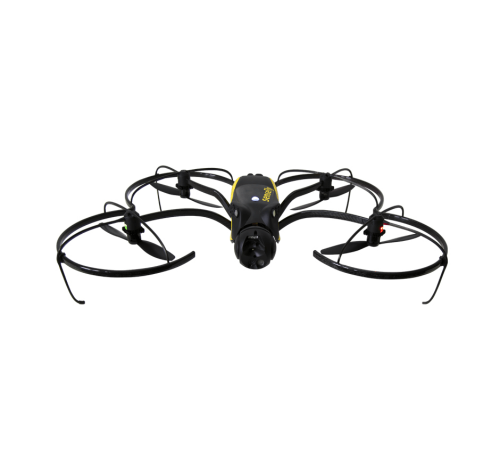
Meet albris, the sensor-rich drone for professionals, offering TripleView imaging and advanced situational awareness.
With the albris you can switch between capturing video, still and thermal imagery during the same flight, without landing to change cameras. The field of view remains unobstructed throughout the 180º vertical range of motion allowing you to capture clear and stabilised imagery ahead, above and below the drone.
The albris features five dual-sensor modules, positioned around the drone. These provide the situational awareness required to operate albris close to structures and surfaces, to achieve sub-millimetre image resolutions (without the movement issues sometimes caused by zooming from afar, and even in confined environments).
The albris offers full flight mode flexibility. Choose the mode that best fits your project: an Autonomous, GPS-guided mapping mission or a live-streaming Interactive ScreenFly flight. Or start in mapping mode and ‘go live’ on demand.
The albris is a sensor-rich platform with the widest camera breadth of any civilian drone. Its fully stabilised TripleView camera head allows you to switch between HD and thermal video imagery, live during your flight, plus you can capture high-resolution still images on demand. All of this data can be saved for further analysis post-flight, and all without landing to change payloads.
The TripleView head features a 180-degree vertical range of motion, 6x digital zoom, active gimbal stabilisation and, thanks to the albris' shrouding frame design, an unobstructed field of view. The albris is capable of achieving a GSD of down to 1 mm at a surface distance of 6 m (19.7 ft).
The albris is designed from the ground up to perform live inspections of buildings and other structures. Its onboard navcams and ultrasonic sensors provide the visual and proximity feedback you require to take the right decisions and maximise every mission’s chances of success.
This high level of operator awareness makes albris particularly suitable for sensitive or dangerous sites, such as cliff faces, flare stacks, bridges and more.
Fully autonomous: Are you looking to map a small site, such as a plant or construction site, directly from above? Or maybe a specific point of interest such as a building or tower? If so, choose an autonomous albris mission.
Suits: high-res 2D mapping, 3D building mapping, construction monitoring, agricultural & archaeological mapping.
Interactive ScreenFly mode: Need to perform a live inspection? Use albris ScreenFly controller to fly an assisted interactive mission.
Suits: structural inspection & documentation, crack/defect detection, solar panel analysis, tower inspection etc.
After albris lands, simply use eMotion 3’s built-in Flight Data Manager to pre-process, geotag and organise its images, before starting image processing.
Then use professional image processing software to transform the drone’s images into geo-referenced orthomosaics, 3D building models, 3D point clouds, triangle models, digital surface models and more. Pix4Dmapper software for example, an option with every senseFly drone, makes this processing simple. It includes a Rapid Check feature, mosaic and rayCloud editors, a point cloud fly-through producer and much more.
Endurance: 22 mins
Range: 2km
Payload: Not specified
Meet albris, the sensor-rich drone for professionals, offering TripleView imaging and advanced situational awareness.
With the albris you can switch between capturing video, still and thermal imagery during the same flight, without landing to change cameras. The field of view remains unobstructed throughout the 180º vertical range of motion allowing you to capture clear and stabilised imagery ahead, above and below the drone.
The albris features five dual-sensor modules, positioned around the drone. These provide the situational awareness required to operate albris close to structures and surfaces, to achieve sub-millimetre image resolutions (without the movement issues sometimes caused by zooming from afar, and even in confined environments).
The albris offers full flight mode flexibility. Choose the mode that best fits your project: an Autonomous, GPS-guided mapping mission or a live-streaming Interactive ScreenFly flight. Or start in mapping mode and ‘go live’ on demand.
The albris is a sensor-rich platform with the widest camera breadth of any civilian drone. Its fully stabilised TripleView camera head allows you to switch between HD and thermal video imagery, live during your flight, plus you can capture high-resolution still images on demand. All of this data can be saved for further analysis post-flight, and all without landing to change payloads.
The TripleView head features a 180-degree vertical range of motion, 6x digital zoom, active gimbal stabilisation and, thanks to the albris' shrouding frame design, an unobstructed field of view. The albris is capable of achieving a GSD of down to 1 mm at a surface distance of 6 m (19.7 ft).
The albris is designed from the ground up to perform live inspections of buildings and other structures. Its onboard navcams and ultrasonic sensors provide the visual and proximity feedback you require to take the right decisions and maximise every mission’s chances of success.
This high level of operator awareness makes albris particularly suitable for sensitive or dangerous sites, such as cliff faces, flare stacks, bridges and more.
Fully autonomous: Are you looking to map a small site, such as a plant or construction site, directly from above? Or maybe a specific point of interest such as a building or tower? If so, choose an autonomous albris mission.
Suits: high-res 2D mapping, 3D building mapping, construction monitoring, agricultural & archaeological mapping.
Interactive ScreenFly mode: Need to perform a live inspection? Use albris ScreenFly controller to fly an assisted interactive mission.
Suits: structural inspection & documentation, crack/defect detection, solar panel analysis, tower inspection etc.
After albris lands, simply use eMotion 3’s built-in Flight Data Manager to pre-process, geotag and organise its images, before starting image processing.
Then use professional image processing software to transform the drone’s images into geo-referenced orthomosaics, 3D building models, 3D point clouds, triangle models, digital surface models and more. Pix4Dmapper software for example, an option with every senseFly drone, makes this processing simple. It includes a Rapid Check feature, mosaic and rayCloud editors, a point cloud fly-through producer and much more.
Endurance: 22 mins
Range: 2km
Payload: Not specified